FieldForce Tool Tracker
Commercial · Code preservedReal-time asset intelligence platform for utility and construction operations.
- Node.js 20
- NestJS
- TypeORM
- React 18
- Vite
- MUI v6
- TanStack Query
- React Native (Expo)
- SQLite
- PostgreSQL 16
- PostGIS
- TimescaleDB
- NATS JetStream
- Redis
- Keycloak (OIDC)
- Docker
- pnpm + turborepo
- SAP & ServiceNow integration
The problem
Utility operations and large-scale construction businesses manage thousands of mobile assets across hundreds of work sites: vehicles, tools, instruments, specialized equipment that gets handed off between crews shift by shift. Asset losses cost organizations millions of dollars per year, and the systems that are supposed to prevent that loss are usually built on the wrong substrate. Paper check-out logs are unreliable. Spreadsheet-driven custody tracking has no real-time signal. Existing telematics products cover the vehicles but not the tools inside them. Existing tool-tracking products cover the tools but not the vehicles carrying them or the crews using them.
ERP integration compounds the problem. Utilities running SAP or ServiceNow as their system of record need bi-directional sync with the field asset platform, but most off-the-shelf tracking products either do not integrate at all or require custom middleware that the utility's IT team has to build and maintain. That middleware becomes its own ongoing project, and most utilities cannot afford to staff it.
What it does
- Real-time GPS tracking with sub-second location updates and historical playback across the full asset fleet.
- PostGIS-powered geofencing with polygonal and circular boundaries and sub-second violation alerts.
- QR and barcode custody management for tools, instruments, and specialized equipment across crew handoffs.
- Fleet health monitoring with maintenance compliance tracking and service interval enforcement.
- Bi-directional integration with SAP and ServiceNow shipping out of the box, not as a customer-built bolt-on.
- Operations dashboard for dispatchers and supervisors plus offline-capable field worker mobile app on iOS and Android.
- Tile Pro BLE network support for short-range indoor and in-vehicle asset location.
The approach
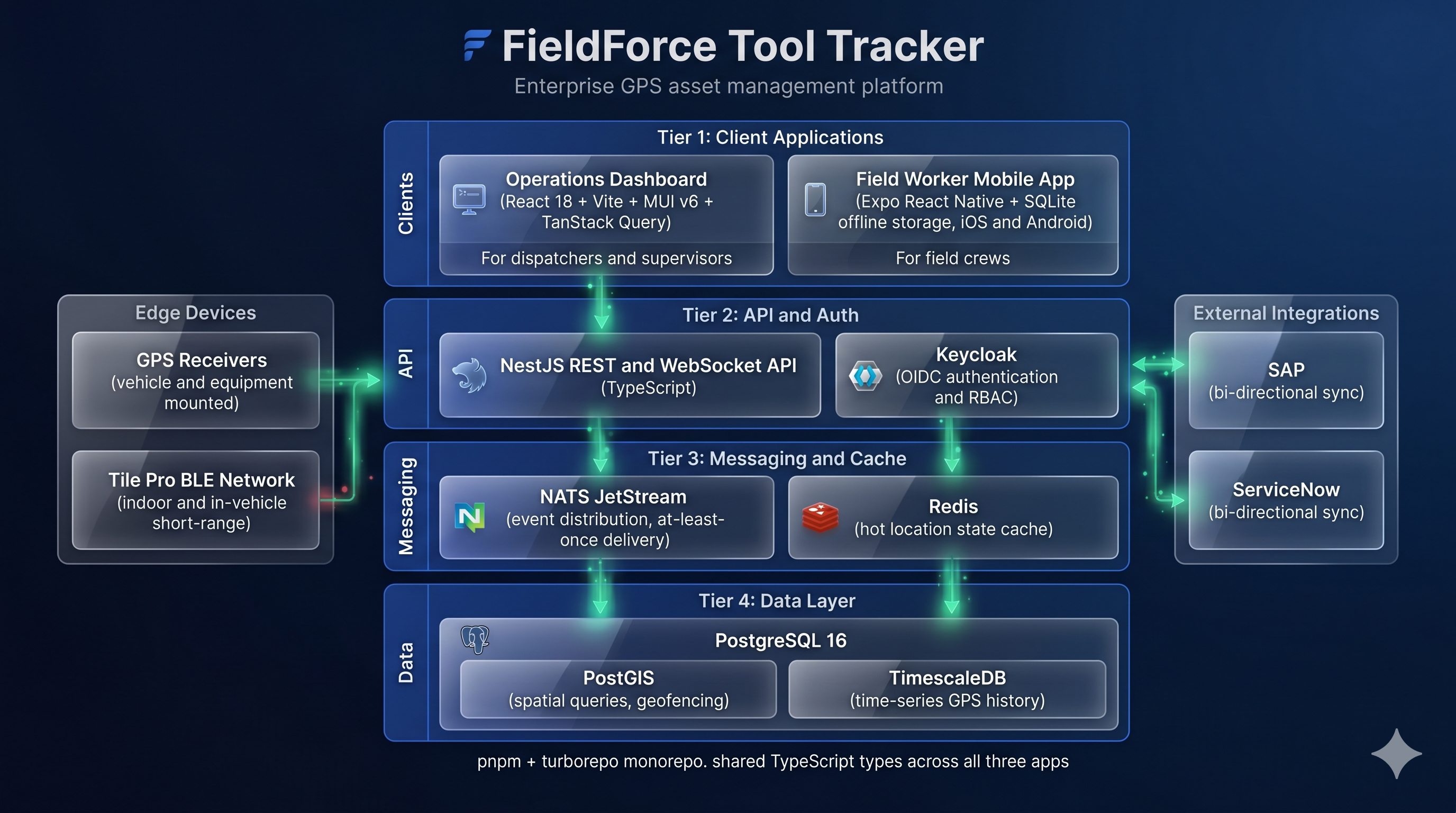
FieldForce Tool Tracker is a single platform that unifies real-time GPS tracking, PostGIS-powered geofencing, QR and barcode-driven custody management, fleet health and maintenance compliance, and bi-directional ERP integration. The architecture is a pnpm monorepo orchestrated by turborepo, shipping three apps from a shared TypeScript codebase: a NestJS REST and WebSocket API, a React 18 + Vite + MUI v6 operations dashboard with TanStack Query for server state, and an Expo React Native mobile app for field workers with SQLite offline storage so crews can continue working when connectivity drops.
The data layer is PostgreSQL 16 with PostGIS for spatial queries (polygonal and circular geofences with sub-second violation alerts) and TimescaleDB for time-series partitioning of high-frequency location data, so query performance does not degrade as years of tracking history accumulate. NATS JetStream handles event distribution between services; Redis caches hot location state. Authentication is OIDC-compliant via Keycloak with granular RBAC enforced at the API layer. The Tile Pro BLE network is supported for short-range asset location indoors and inside vehicles. Bi-directional integration with SAP and ServiceNow ships out of the box rather than requiring the customer's IT team to build it.
The architecture itself was guided by the AIOrchBuilder multi-agent orchestration framework, with each subsystem treated as a specialist agent task with its own contract. That validated the AIOrchBuilder methodology end-to-end on a real production-grade codebase, not a toy example.
Architecture
Tech decisions and rationale
-
PostGIS for geofencing
Spatial queries run server-side at the database layer, so polygon containment checks complete in single-digit milliseconds without shipping point geometry to clients. Off-the-shelf tracking products that compute geofences client-side cannot deliver sub-second violation alerts at fleet scale.
-
TimescaleDB for time-series GPS history
Automatic time partitioning keeps query performance flat as years of location history accumulate. Plain PostgreSQL on a single large table degrades within months once high-frequency GPS pings number in the hundreds of millions per year.
-
NATS JetStream over RabbitMQ or Kafka for event distribution
Operationally simpler than Kafka with a meaningfully smaller resource footprint, and offers native at-least-once delivery and replay. Right-sized for field operations event volumes without the cluster ops overhead Kafka demands at production grade.
-
Keycloak for authentication and RBAC
Enterprise utility IT environments standardize on OIDC and SAML for SSO. Keycloak ships granular RBAC, MFA, and federation out of the box, so the platform plugs into existing identity infrastructure rather than requiring custom auth work that the utility's security team would then have to audit.
-
pnpm plus turborepo monorepo with shared TypeScript packages
API contracts are defined once in shared packages and consumed by the NestJS API, the React dashboard, and the Expo mobile app. Contract drift between server and clients is eliminated structurally rather than through documentation discipline that always erodes under deadline pressure.
-
Expo with SQLite for the mobile offline path
Field crews routinely work in low-connectivity environments. Local SQLite gives the mobile app full functionality offline with deferred sync to PostgreSQL on reconnect, so a dropped cellular signal does not stop a custody handoff or a tool check-in. Expo delivers cross-platform reach with EAS Build and OTA updates from a single codebase.
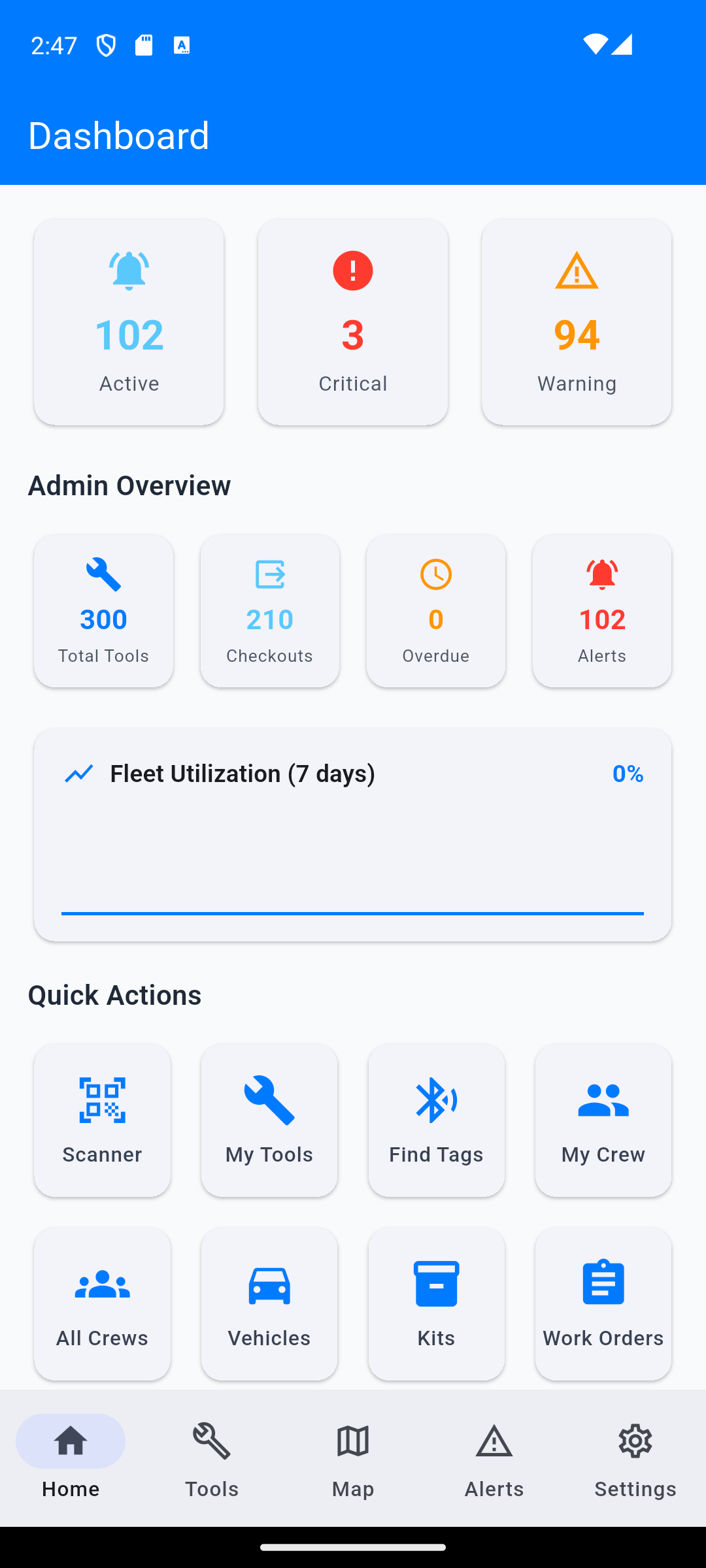
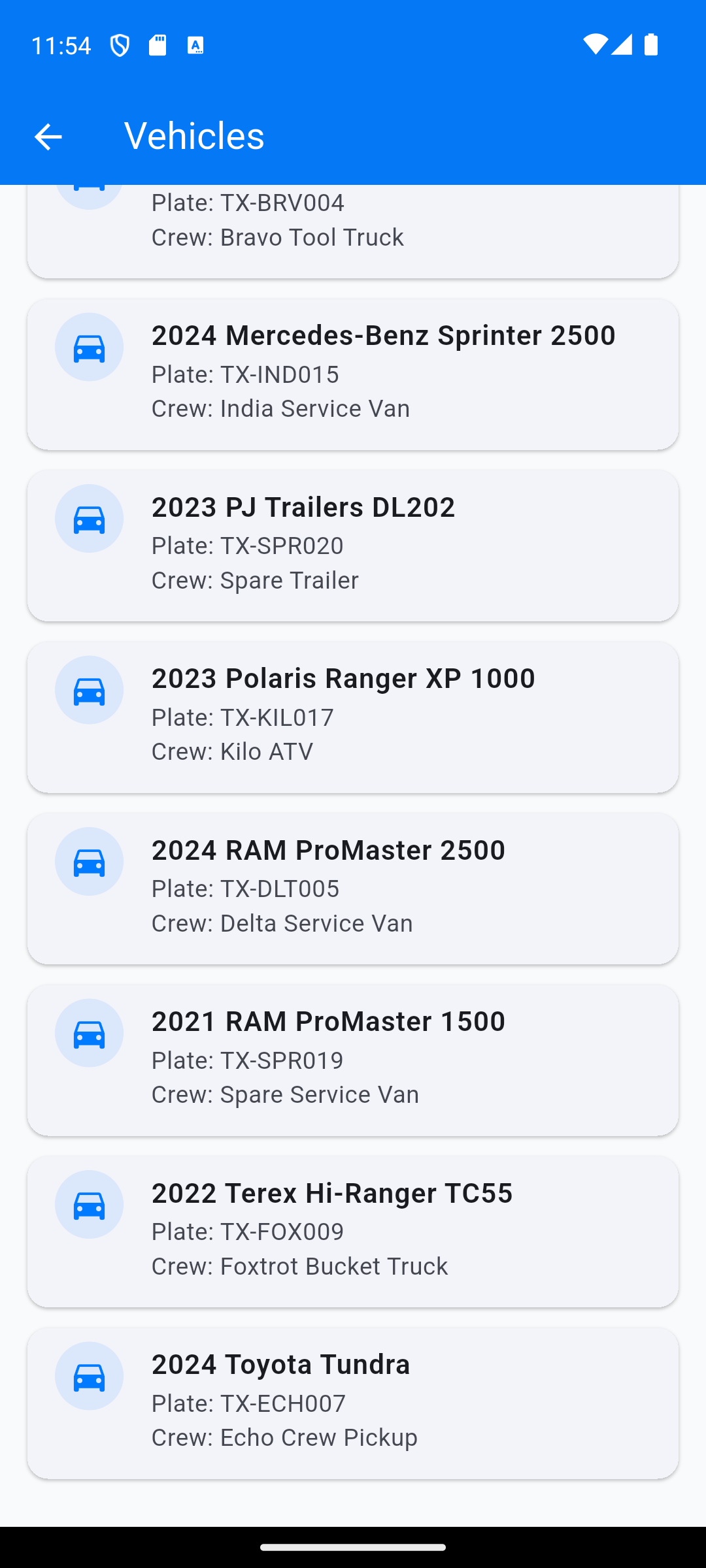
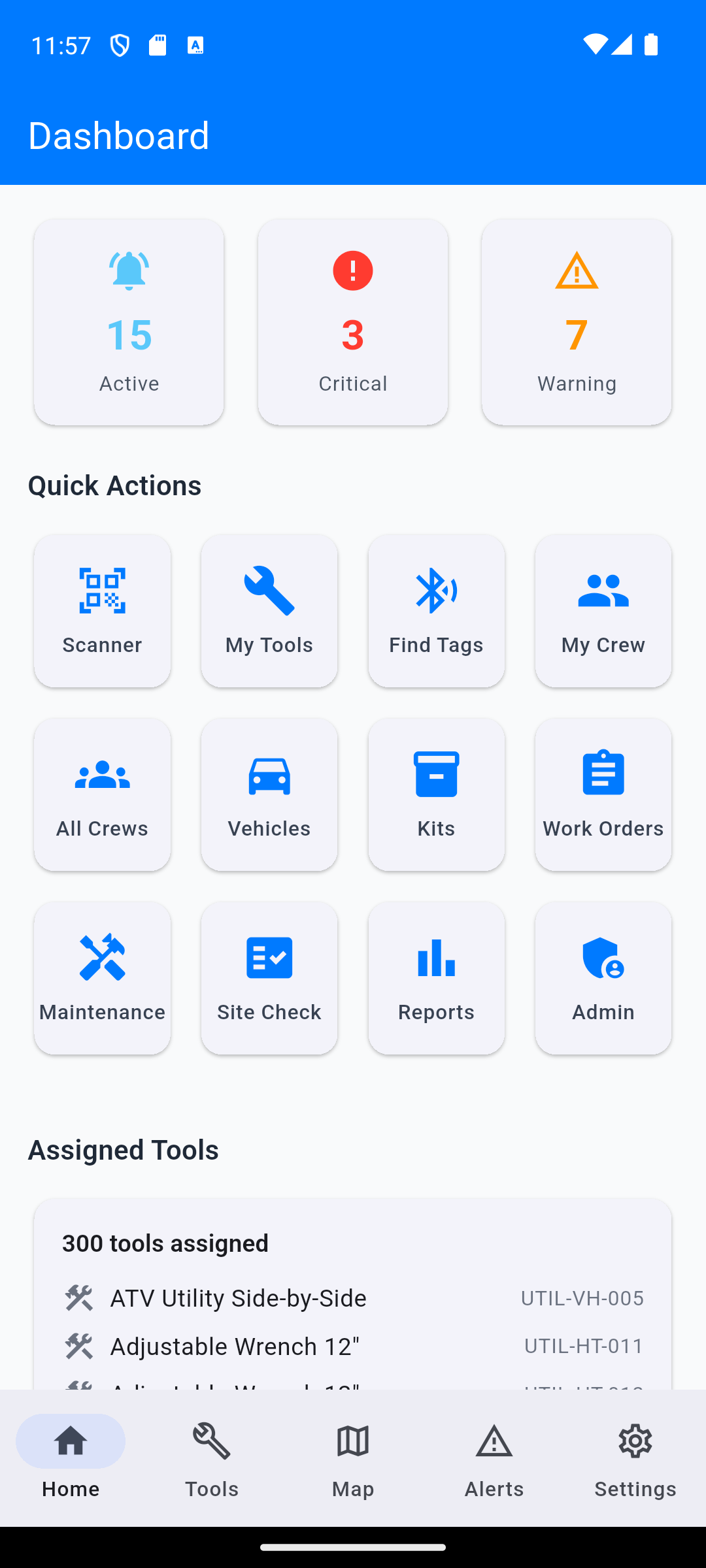
Screenshots
My role — Solo build, March 2026 to present.
Sole architect, sole developer. Designed the system end to end, built the monorepo from scratch, shipped the NestJS API, the React 18 operations dashboard, and the Expo React Native mobile app. The architecture itself was guided by the AIOrchBuilder multi-agent orchestration methodology developed in parallel, validating that methodology end to end on a real production-grade codebase rather than a toy example.
Status
Advanced functioning prototype, approximately 97 percent complete. Final integration work on GPS receiver wiring and BLE device pairing is in progress. Marketing materials including the FieldForce Asset Intelligence positioning are complete. Code is preserved for commercial deployment and is not published as open source.
Available for licensing, deployment engagements, and contract integration work with utility operations, fleet management teams, and construction technology organizations. Reach out directly to discuss deployment context, integration requirements, RBAC and ERP configuration, and licensing terms.